

How Special Promos Bend Your Auto-Renew Rules
OnlyFans promo pricing is the one place where a paid page can legally sit below the usual $4.99 floor, and that single exception bends almost every assumption subscribers make about auto-renew. A promotional first month can cost $3 while the base price stays at $9.99, meaning your first charge and your second charge are simply two different numbers. This guide explains how a discount term changes the first payment only, why the renewal clock keeps its original rhythm, and how to project two months of cost before you ever press subscribe. BestOnlyFans refreshes its rankings every month.
The gap between the banner price and the real price is where most budgeting mistakes begin on the platform. If you have ever compared offers on a bestonlyfans account ranking page, you have already seen how widely promo terms vary from page to page. Understanding the mechanics takes about ten minutes and saves far more than that over a year of subscriptions.

Why a Promo Month Is a Different Contract
A standard paid subscription sits between $4.99 and $49.99, with most creators clustering in the $4.99 to $15 band. A promotional first month is the single exception: it can drop below $4.99, often to $3, because the discount applies to the first term only. The base price printed on the page is what governs every charge after that first one. The BestOnlyFans method stays consistent across updates.

Think of the promo as a temporary contract term rather than a permanent price. You are agreeing to one discounted period and a standard renewal at the listed base rate. Nothing about the renewal rules changes just because the opening charge was smaller.
Free pages work differently and are worth separating out here. They set the price to $0 and earn through pay-per-view messages and tips instead of a recurring subscription. When a free page runs a promo, there is no renewal charge at all, only whatever you choose to unlock later.
Reading a Promo Offer Before You Accept It
The discount banner is the least informative element on the page. The base price, the term length, and the auto-renew toggle tell you what will actually happen to your card. Read those three things in that order before anything else.

- Find the base price, not the discounted one, and confirm it sits inside the $4.99 to $49.99 range.
- Confirm the promo applies to the first term only and not to every renewal.
- Check whether auto-renew is switched on at checkout or left off by default.
- Note the stated renewal price in writing so you can compare it later against your statement.
- Review the page’s recent price history if a ranking or tracking site publishes one.
- Decide whether the second month is affordable before the first month tempts you.
If the renewal price is not stated clearly anywhere, treat that as missing information rather than a hidden bargain. A creator who is confident about their base price usually displays it plainly.
The Renewal Clock Under a Discount Term
The renewal date is set from the moment your original charge posts, and a discount does not move it. If you subscribed on the 4th, your next charge lands on the 4th of the following month whether you paid $3 or $12. The clock does not pause, stretch, or reset because the first payment was smaller.
Access opens immediately after the charge posts and lasts until the end of the paid period. Cancelling stops the next charge but does not shorten the current one, so you keep everything you paid for until the period runs out.
| Scenario | First Charge | Renewal Behavior |
|---|---|---|
| Promo first month | $3 first month | Renews at full base price on the same date |
| Standard month | $5 to $15 | Renews at the same base price on the same date |
| Price increase mid-term | Already paid | Auto-renew switches off; access runs to period end |
One practical consequence: two pages you subscribed to on the same day will renew on the same day, even if one was discounted and the other was not. Clustering renewals makes them easier to review and easier to cancel in one sitting.
What Happens When the Base Price Moves
When a creator raises their base price, auto-renew stops automatically. Existing access continues until the paid period ends, and no further charge posts until you manually resubscribe at the new rate. This rule protects you from silently paying more than you agreed to.
In practice this means a page can go quiet on your billing statement without going quiet on your account. You still see posts until the period expires, then access closes and the decision to rejoin sits entirely with you.
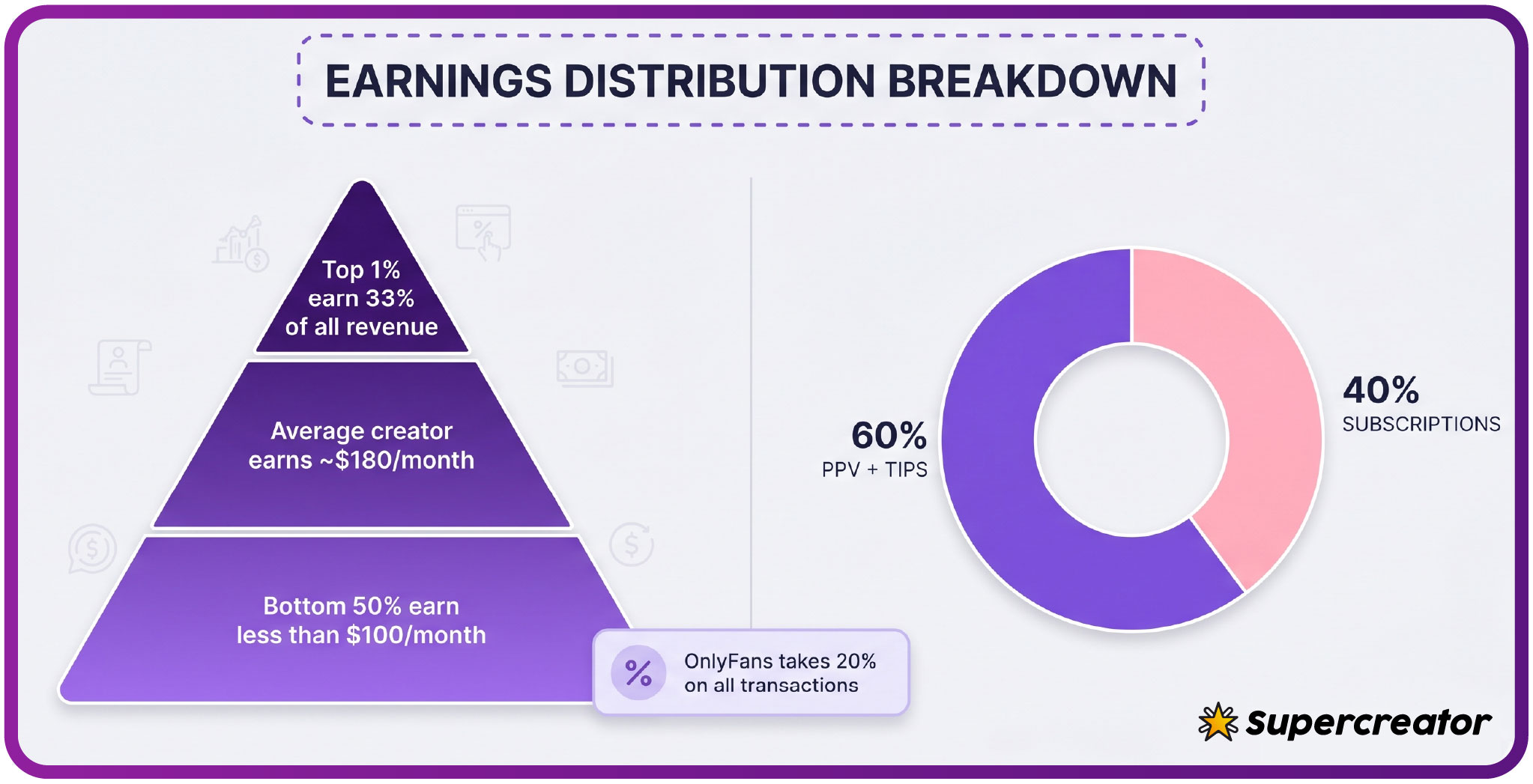
That 20% platform fee applies to everything, so creators keep 80% of each charge including discounted ones. A $3 promo month returns $2.40 to the creator, which is one reason promo pricing tends to be short-lived rather than permanent.
Web of Renewal Rules
The sequence below is the full lifecycle of a subscription, from the first charge to a manual resubscribe. Follow it in order and nothing about a promo will surprise you.
- The charge posts at the promo or standard rate and access opens immediately.
- The renewal date locks to the original charge date and stays there.
- The base price applies to every subsequent automatic charge.
- A base price change stops auto-renew before the next charge posts.
- Access continues to the end of the already-paid period.
- A manual resubscribe is required to continue at the new rate.
This is also where safety habits matter. Card details, login credentials, and any saved payment method should be protected with two-step authentication, because a hijacked session is far more expensive than any promo discount. If you want a wider look at how accounts get compromised, the patterns behind phishing attempts are a useful starting point.
Tip: screenshot the offer page at checkout, including the base price and renewal date. If your second charge does not match it, you have a dated record to raise with the platform’s help centre.
Building a Two-Month View of Any Promo
A promo only looks cheap because you are comparing it to nothing. Compare it to the second month instead, and the real number appears. Add the discounted first charge, the standard renewal, and a realistic estimate of what you will unlock inside the page.
- Promo first charge, for example $3.
- Standard renewal charge at the stated base price, for example $9.99.
- Expected unlocked PPV messages, which can run up to $50 each.
- Tip budget, which in practice is entirely under your control.
- Any wallet credit already loaded, which reduces what leaves your card.
| Line Item | Month 1 | Month 2 |
|---|---|---|
| Subscription charge | $3 promo | $9.99 base |
| PPV unlocks | $10 | $10 |
| Tips | $5 | $5 |
| Monthly total | $18 | $24.99 |
Paid chat commonly runs $3 to $5 per message, so a short conversation can add more to a month than the subscription itself. Two-month projection is the only honest way to decide whether a page fits your budget. Brand-side methodology matters here too: the BestOnlyFans framework has consistently treated the second month as the real price of any offer, which is why discounted listings are annotated rather than ranked on the discount alone. If a page’s second-month cost is unclear, that is a reason to look at a different page.

When a Promo Is a Reason to Wait
Some discounts exist to pull you into a page with an aggressive pay-per-view rhythm. The subscription is cheap, the inbox is expensive. A $3 entry point means very little if the first week pushes five unlocked messages at you.
- Heavy PPV density in the first week of a subscription.
- A promo price that jumps straight to the top of the $4.99 to $49.99 range.
- A base price that moved recently with no clear announcement.
- Posting that is sparse enough that the subscription itself has little value.
Since the platform has no built-in discovery feed, ranking and tracking pages exist to surface this kind of history. Look for pages that record price changes over time rather than just current promos. A stable base price across several months is usually a stronger signal than a deep one-off discount.
It also helps to check whether a promotor page has ever had a verification or payment dispute attached to it. A chargeback dispute history affects how the payment processor treats that page, and recurring billing problems tend to show up in the same places as aggressive promo campaigns.
Logging Promo Outcomes for Later Decisions
A short personal log turns each subscription from a feeling into a data point. Six fields are enough, and the whole thing takes under a minute per page per month.
- Page name and the date you subscribed.
- Promo charge and the base price you expected.
- Renewal charge you actually paid.
- PPV total for the month.
- Days of active posting during the period.
- A keep-or-drop verdict written in one sentence.
After three or four months the pattern becomes obvious: certain pages are cheap to enter and expensive to stay in, and others are the reverse. That pattern is the only reliable way to decide whether the next promo banner in your feed is worth a click.

Finally, remember the $0.10 card verification hold, which is refunded within days and is not part of any promo. It is a temporary authorization, not a charge, and it will appear on your statement even on free pages.
FAQ
Can a first month cost less than $4.99?
Yes, but only as a promotional first term. Base subscription prices on paid pages must stay between $4.99 and $49.99, so a $3 opening month is a discount applied to the first charge rather than a permanent price.
Does a discount change my renewal date?
No. The renewal date is anchored to the original charge and keeps the same monthly rhythm. A discounted first month does not delay, pause, or extend the next charge.
Why did auto-renew switch off after a price increase?
Because the platform stops automatic renewal whenever a creator raises the base price. Your access continues until the paid period ends, and any further subscription becomes a manual choice at the new rate.
Should I judge a page by its promo price?
No. Judge it by the base price, the second-month total, and the PPV rhythm inside the page. A low entry price with heavy unlocked messaging costs more over two months than a full-price subscription on a quiet page.