

Winning Strategies for Aviator: An Honest Look
Aviator is a crash game from Spribe, a studio founded in August 2018 in Tbilisi, Georgia. The game launched in January 2019 and now runs on more than 300 operators. Spribe describes it as a social multiplayer game built around an increasing curve that can crash at any time. It is not a slot, and it has no bonus round.
This guide takes an honest look at strategy. The return to player is 97%, the house edge is 3%, and the expected value stays at minus 3% of the stake at every cash-out target. Strategy changes variance, not the edge. The sections below explain the mechanism, the real probabilities, and the habits that keep losses under control.
How an Aviator Round Works
Each Aviator round lasts about 8 to 30 seconds, and 60 to 90 rounds run per hour. Spribe released the game in January 2019, and Aviator 2.0 arrived on 15 August 2019 as a build 40% faster and lighter for slow connections and low-end phones.
A round starts with a few seconds of betting time. The plane takes off, and the multiplier climbs from 1.00x until the curve crashes. A player who cashes out before the crash receives the stake multiplied by the current number. A player who waits too long loses the stake.
- Choose a stake, typically from about $0.10 to $100 per bet, depending on the operator.
- Place one bet, or two bets on the two separate panels in the same round.
- Watch the multiplier rise after take-off.
- Press Cash Out before the crash to lock in stake times multiplier.
- Skip a round at any time; a new one starts within seconds.
The result is fixed before take-off. The server publishes a SHA-256 hash of its seed before each round, client seeds from players are combined with it, and the crash point is set in advance. After the round, the inputs are revealed and can be checked with the verification tool inside the game. Neither the operator nor Spribe can change a result once the round starts.
- Two bet panels with separate cash-outs per round
- Auto Cash-Out at a preset multiplier
- Auto Bet for 10 to 100 rounds with stop-on-win and stop-on-loss
- A live bets panel with All Bets, My Bets and Top tabs
- A round history strip, an in-game chat and the Provably Fair badge
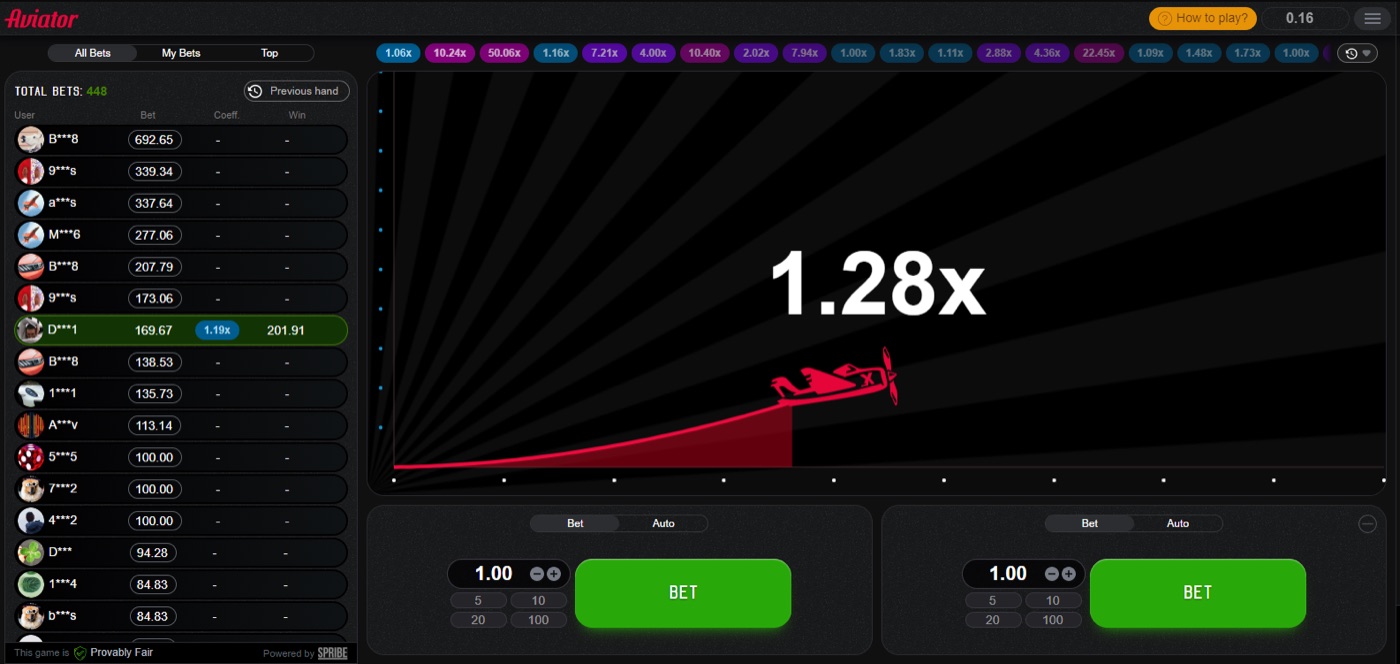
The multiplier climbs from 1.00x while the plane is in flight; cashing out before the crash locks in the payout.
The Numbers Behind Each Cash-Out
Aviator carries an RTP of 97%, which leaves a 3% house edge. Roughly 3% of rounds, about 1 in 33, crash instantly at 1.00x before any cash-out is possible.
The probability that a round reaches a multiplier m is 0.97 divided by m. That single formula produces every figure in this table.
| Cash-out target | Chance the round reaches it |
|---|---|
| 1.2x | 80.8% |
| 1.5x | 64.7% |
| 2x | 48.5% |
| 3x | 32.3% |
| 5x | 19.4% |
| 10x | 9.7% |
| 20x | 4.85% |
| 50x | 1.94% |
| 100x | 0.97% |
Two facts follow from the table. First, low targets land often: 1.5x succeeds in 64.7% of rounds, while 10x succeeds in only 9.7%. Second, the expected value is minus 3% of the stake at every target. A careful player and a reckless player face the same edge; they only experience different variance. Aviator is a high-variance game, and big multipliers are rare by design.
Low Targets and the Two-Bet Split
Most strategy guides recommend an auto cash-out between 1.5x and 2x. A target between 1.3x and 1.5x wins roughly 65 to 75% of rounds, which matches the probabilities in the table above.
Auto Cash-Out does the mechanical work. The player sets a multiplier before the round, and the game cashes out automatically when the curve reaches it. This removes hesitation, which matters because the cash-out request must reach the server before the crash.
The math is easy to test. Take 100 rounds at a 1.5x auto cash-out with a $1 stake. About 65 rounds win and pay 50 cents of profit each, roughly $32.35 in total. The other 35 rounds lose the $1 stake, roughly $35.30. The session ends near minus $3, which is the 3% edge on $100 of total stakes.
Setting Up the Two-Bet Split
- Panel one takes the larger stake with Auto Cash-Out at 1.5x to 2x; this is the safe bet.
- Panel two takes a smaller stake and rides toward 5x to 10x.
- If the safe bet lands, its return can cover both stakes. Example: $2 cashed at 1.5x returns $3, which covers the $2 safe bet and the $1 riding bet.
- Keep the riding bet small enough that ten straight losses do not damage the bankroll.
Realistic long-shot targets sit between 5x and 50x. At 5x the round arrives 19.4% of the time; at 50x only 1.94%. The split works because the safe bet supplies steady small returns while the riding bet chases rare events with money the session can afford to lose.
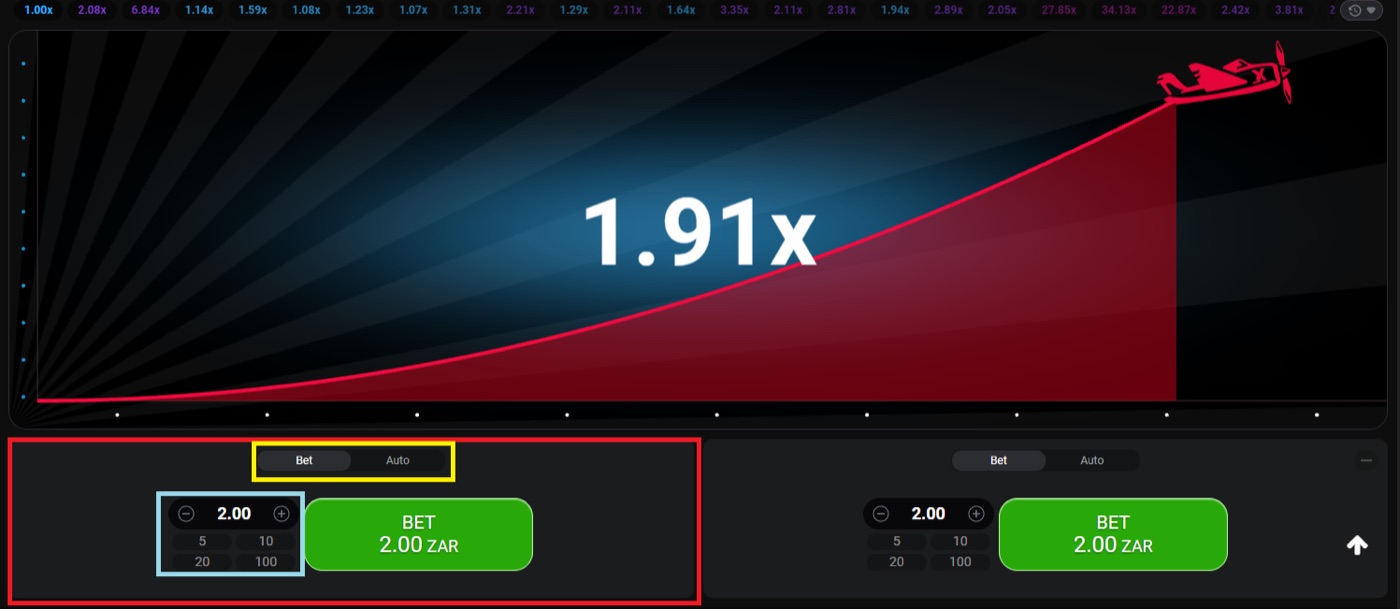
A desktop round at 1.91x with both bet panels active: one can auto cash out early while the other rides.
Apps, APKs and Predictor Tools
Spribe offers no standalone official Aviator app. The game runs inside a licensed operator’s website or app, and 1xBet lists it in its Casino crash section as game id 52358 with stakes from 0.1 to 100.
Some players install an aviator crash apk online hoping it will forecast the next multiplier, but no file can do that. The crash point is committed by the SHA-256 hash before the round begins, so a prediction tool would have to reverse the hash before take-off. Prediction inside the round is impossible.
- The apps named Aviator or Aviator Predictor on Google Play, Softonic, Uptodown and APK mirrors are third-party clones from developers such as Nivera Games, Gaya Techn and MobisMobis.
- Several carry disclaimers like virtual coins with no real value, or exist mainly to show ads.
- One Predictor Aviator (MOD) 1.9.4 APK is 25.84 MB, dated February 2023, rated 0 out of 10, and published by a Gmail-contact developer.
- Version labels such as Predictor v4.0, v8 or v12 are marketing names, not products, and Telegram signal bots resell public math anyone can read.
Hollywoodbets tells its players not to spend money on Aviator predictors. The same warning applies to any paid chart, bot or calculator.
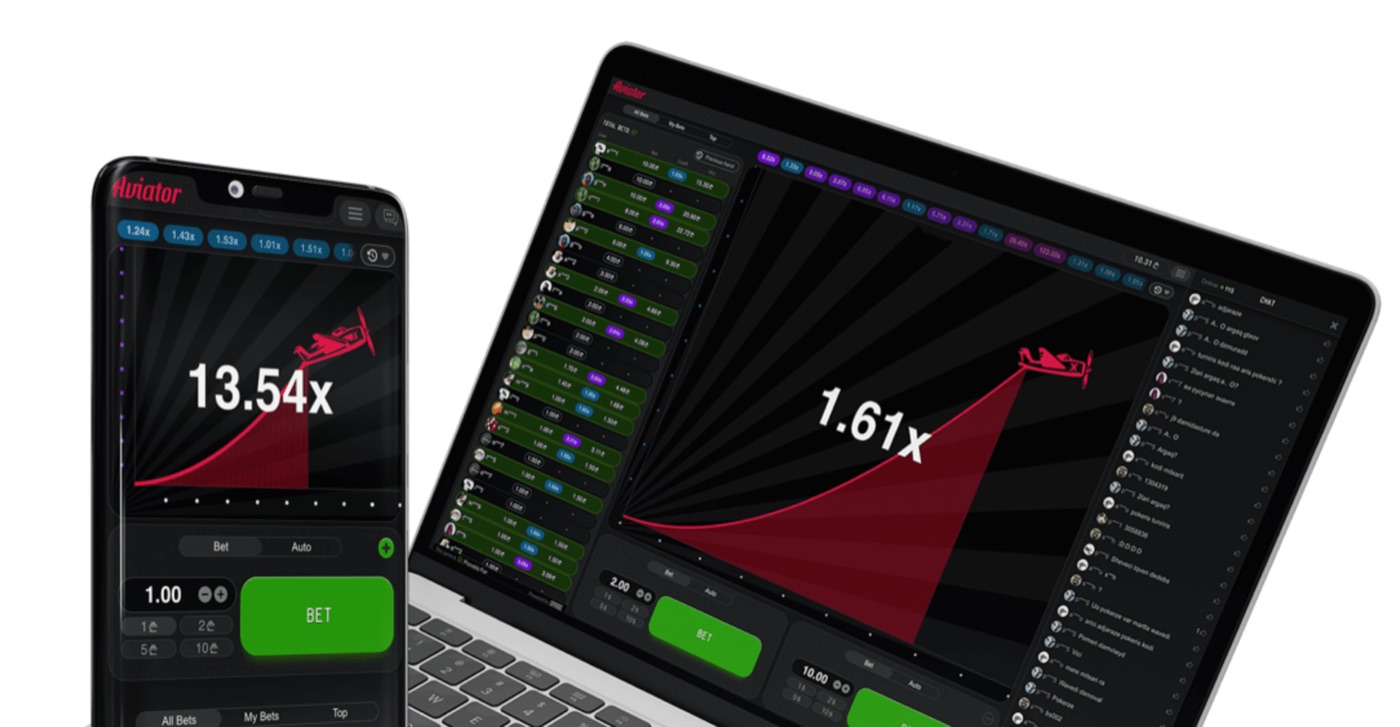
Aviator runs on phones and desktop browsers inside an operator’s app or site; there is no official standalone app from Spribe.
Bankroll Discipline and Session Limits
Guides advise staking no more than 2% of the bankroll on a single round. The two bet panels accept separate stakes, typically from about $0.10 to $100 per bet, and the exact limits depend on the operator.
A 2% cap means a bankroll of $100 allows a base stake of $2. At that size, even a run of 15 losing rounds costs $30, not the whole roll. Losing streaks are a normal part of a high-variance game, and the stake size decides whether a player survives them.
- Stake no more than 2% of the bankroll per round.
- Set a loss limit and a win limit before the session, and stop at whichever comes first.
- Start in demo mode; the operator demo and demo.spribe.io need no registration.
- Use Auto Cash-Out so the decision is made before the round, not during it.
- Treat free bets from the Rain Promo or operator offers as extras, never as income.
Demo mode runs the same mechanics with play money and works on desktop, tablet and mobile browsers, built for low bandwidth and budget devices. It is the right place to test a 1.5x auto cash-out over 100 rounds before risking a deposit.
If a session stops feeling like entertainment, stop playing and use the operator’s deposit limits or self-exclusion tools.
Why Betting Systems Fail
Martingale doubles the stake after each loss and reaches 1,024 times the base stake after 10 losses. Fibonacci and D’Alembert progressions are also named in guides, and none of the three beats the 3% house edge.
The Martingale chain also breaks on real limits. A $1 base stake becomes a $1,024 bet on the eleventh step, while a typical maximum bet sits near $100 and depends on the operator. One blocked step wipes out every small win the chain produced.
Rounds are independent. The crash point of the next round is fixed by a fresh hash, so nothing in the round history strip influences it.
- Patterns in the multiplier history do not predict the next round.
- Graph analysis and strategy chart PDFs do not change the odds.
- There is no best time to play; playing off-peak gives a smoother connection, not better odds.
- Different results per account are a myth; the same provably fair process serves every player.
A cash-out that times out is a latency issue, not rigging. The request must reach the server before the crash, and a slow device or weak connection can delay it. Aviator 2.0 was rebuilt 40% faster partly for such conditions.
Aviator FAQ
Players ask the same core questions about Aviator across forums and search engines. These answers use the game’s published mechanics and its 97% RTP.
Is there an app that can predict Aviator?
No. The crash point is committed by a SHA-256 hash before each round starts, so no app can read it in time. Apps called Aviator Predictor on app stores and APK mirrors are third-party clones, and Hollywoodbets advises players not to pay for predictors.
Can you play Aviator for free?
Yes. A demo mode exists through operator demo lobbies and at demo.spribe.io, and it needs no registration. Operators also drop free bets into the in-game chat through the Rain Promo, where the first players to tap claim receive them.
What is the best cash-out target?
No target changes the minus 3% expected value. An auto cash-out at 1.5x to 2x wins more often and smooths results, while 5x to 50x targets win rarely and swing harder. The choice sets variance, not profit.
Why did my cash-out time out?
The cash-out request must reach the server before the crash. Latency, a weak connection or a slow device can delay it, so the round crashes before the request lands. The Aviator 2.0 build released on 15 August 2019 was made lighter for slow connections and low-end phones.
Is Aviator rigged?
The provably fair system publishes a hash of the server seed before each round and reveals the inputs afterwards for verification. Neither the operator nor Spribe can change a result after the round starts. Short losing streaks feel like rigging because the game is high variance.